Introduction
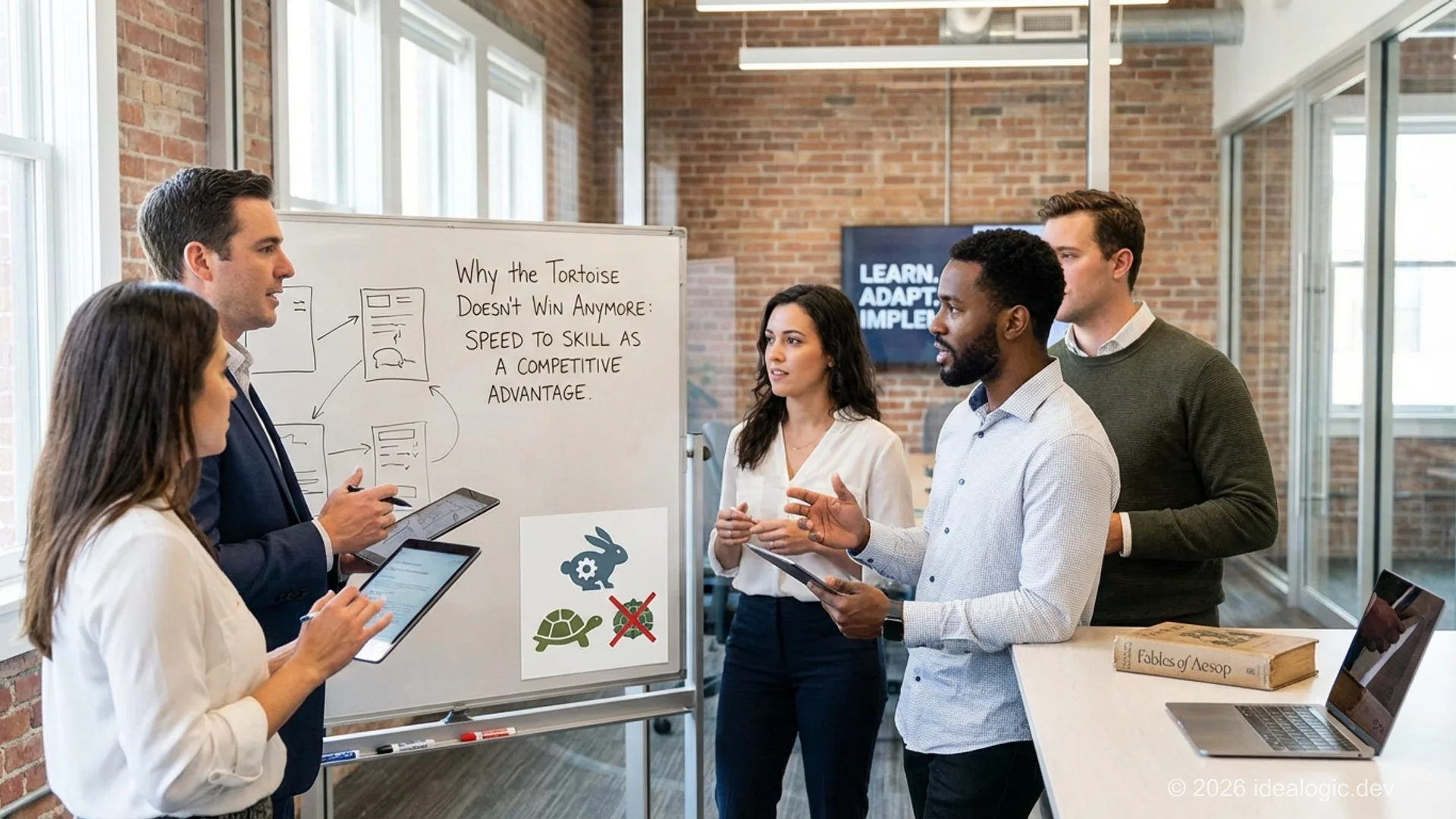
The fable "The Tortoise and the Hare" has been teaching the lesson of patience and persistence for 2,000 years. The proverb says, slow and steady wins the race. Premeditated, processional rush overpowers pace. However, in the modern business environment, that is becoming an outdated moral. This is the age of speed to skill, of how fast individuals and organizations can learn, adapt and implement new capabilities. This is one of the defining competitive advantages. As a matter of fact, it could be the competitive advantage that remains sustainable as the only one. The new game is to determine who can learn the most, be able to apply what they have learned in real time, and attain the greatest ROI before the landscape, and the skills required to work within it, change once again. The sustainable benefit of a fast-changing market is the speed with which organizations detect the skill requirements, obtain and put them to practice in real time, before the competitive environment changes once again. Companies such as Google, OpenAI, and Unilever incorporate learning into the work process and use data, quick iteration, and internal mobility to build an end-to-end knowledge acquisition, deployment, and value generation process.
Faster training is necessary to get faster, but faster training is not in itself sufficient to prepare the future skills, to provide psychologically safe environments in which to use them, or to have performance metrics which reward learning agility.
The Hare Learns a Lesson
In the fairy story, the hare is the loser. His arrogance and complacency is a weakness to his natural speed. But suppose another variant, in which the hare has taken his lesson, and knows that he has no time to sleep under a tree. Rather, he analyzes the ground to find the most appropriate way to go, learns through his mistakes and applies his new knowledge right now to go forward, wiser and quicker. It is the winning strategy of business today. The firms are now becoming awarely faster to skill, agile and adaptive. And they are pushing off their competitors, including those who are making slow yet continual improvements.
Learning as an Extreme Sport
Out of the cutting-edge, there are institutionalized learning on the extreme, such as Google and OpenAI, who look at learning as an extreme sport. An example is OpenAI that developed systems that view each launch as a learning experience. Almost every release is A/B tested, and those lessons are learned and used to drive quicker release cycles, which its founders refer to as their learning velocity. Speed to skills is also determined with surgical precision at Google, particularly within the engineering teams. Google has a framework called DORA (DevOps Research and Assessment) that monitors the amount of time it takes teams to:
- Release new code
- Recover from failures
- Make change iterations These measures indicate how expeditious teams are as far as learning the real world is concerned and applying the same to the product.
Fast to Competency
Learning velocity is not specific to tech companies. Unilever has turned out to be an international benchmark of what it entails to create rapidity to proficiency at scale. Employees are able to outline their career paths and competencies they will require through its own talent marketplace. By offering their services on temporary internal projects, they will be able to apply their new skills and get the corresponding learning in a very short time. As it is possible to claim, in a few weeks the marketing expert can acquire the rudiments of data analysis, and can then exercise the acquired knowledge on a data-driven project. This connection between learning, doing, and performing forms a virtuous cycle: the quicker the skills are learned, the quicker they are applied and the quicker they can influence the business.
It is not a mere coincidence that Unilever is always among the most future ready international companies.
Why This Is Important Now
The half-life of skills is dwindling, fast. According to the predictions made by the World Economic Forum, 44 percent of the core skills of workers will be disrupted by 2027. The role of AI in changing the job roles is such that some training programs are becoming redundant before they can be completed. And the time constraint is increasing. In our Fast, Fluid, and Future-Focused study, one out of five organizations indicates that the integration of gen AI, AI, or machine learning into business operations is among its highest priorities this year. It is implied that almost half of them also responded that there are considerably higher expectations of leaders that their teams should be upskilled in AI.
The solution to the speed to skill problem cannot be as simple as faster training delivery. Organizations have to know what skills they will require and this has to be accompanied with setting strategy.
Second, the training should be effective and implementable. Third, all of that should occur in the context of an organizational culture that does not resist the use of new skills—a change seeking organization. It is one of the jobs that not all business leaders and organizations are ready to undertake.
Ready to Accelerate Your Organization's Learning Velocity?
Discover how speed to skill can transform your competitive advantage in today's rapidly changing market.
The Lesson of a New Moral to a New Race
What does all this mean to business leaders? It does not teach that the fastest wins. It is that the pace of learning triumphs in a world that favors wisdom, dexterity and initiative.
As a Leader, Consider the Following Questions:
- Do you have learning embedded in the discussions of your C-suite strategy?
- What is the speed of adoption of new technologies, tools or processes by our teams? How do we know?
- Being aware of our strategy, can our people be given a chance to assist in determining the skills that they will require?
- Does our leadership provide a psychologically safe environment, which makes it conducive to the application of new skills?
- Do our performance measures and rewards match increasing our organizational learning velocity? The only way that the organizations can compete in this new race is by designing at speed to skill. Not only training programs but also systems and environments that sustain learning are contextual, continuous and performance-integrated. It is time to put the ancient fable aside when it comes to learning. Companies that are learning their way to the finish line, what several years ago can be described as faster than ever before, are writing the new one each day.