Introduction
Over the last few years, it can be seen that there has been a huge change in the manner in which industries are thinking about the automation sector, and this can be attributed to the massive convergence of Artificial Intelligence (AI) and robotics. Significantly no longer restricted to limited and pre-programmed action, the current robotic systems are becoming more intelligent and versatile and can learn within the environments in which they function and make real-time decisions. This convergence is not simply the technical enhancement—it is a complete paradigm shift in the way industrial operations are structured, controlled and optimized. With machine learning (ML), these systems are able to work with very large amounts of data, detect patterns and continually optimize their behavior, even without being rewritten. Practically, this translates to more and more of these systems being able to act in unforeseen ways, adapt to the situation, and act with an amount of precision and agility that could never be imagined before. Computer vision also means that these systems can do even those things, and process what they see. It gives the way to more subtle tasks, like:
- The control of quality
- The recognition of the object
- Autonomous navigation on factory floors, which demand a high level of perception and flexibility Simultaneously, real-time decision-making capabilities are also allowing robots to autonomously control production streams, react to dynamic variables, and minimize the importance of constant human supervision, which are all gaining massive productivity increases and operational economies of scale through AI-powered robotics. However, together with the excitement there is a group of serious questions. With the increasingly advanced machines, then what happens to human workers? Are we heading a period of job displacement or job transformation? What would be the ethical considerations when deploying such technologies? Also, this understanding will focus on the larger technological ecosystem that facilitates smart automation—specifically the application of:
- The Internet of Things (IoT)
- Edge computing
- The next-generation connectivity such as 5G The analysis of the ongoing trends, the consideration of real-life examples, and the examination of the overarching consequences of intelligent automation, the proposed study is meant to offer a clear context of how the merger between AI and robotics is transforming the face of the industrial environment. It will also look forward into the challenges that are yet to be overcome, both in technical capacity and regulatory and ethical issues, as we continue to move towards an ever more automated future.
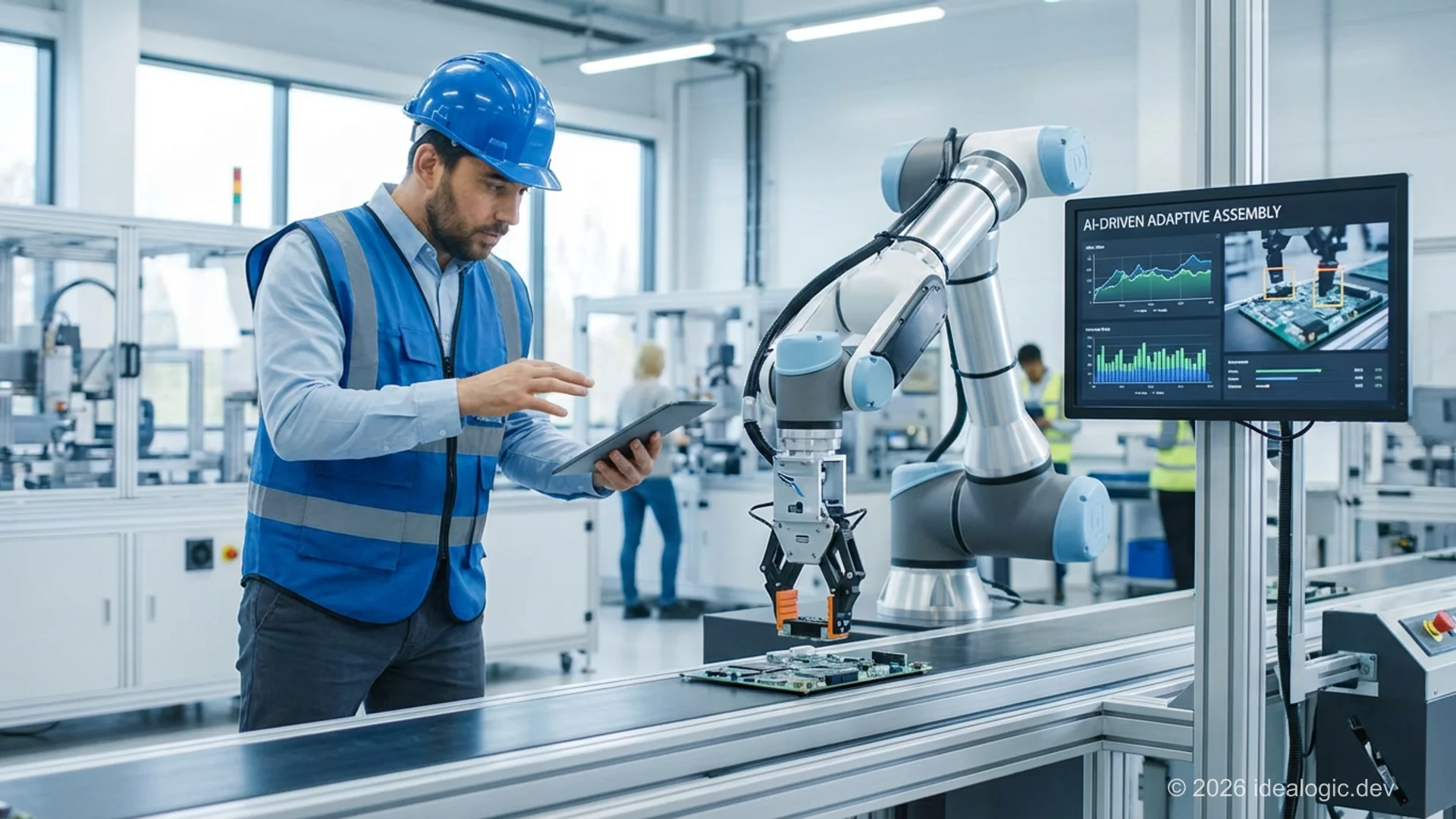
The combination of AI features with robotic equipment has created a new generation of intelligent automation solutions.
Integration of AI and Robotics in Industrial Automation
How does machine learning (ML) improve robotic capabilities?
ML, and especially Deep Reinforcement Learning (DRL), is much more capable of improving robot capabilities by allowing robot coping with more complex and continuous action-space representations that tend to be common in the real world. It is accomplished through combining Neural Networks with conventional Reinforcement Learning and, thus, enables robots to analyze huge volumes of data and make better decisions. The ability of DRA to enhance itself by means of interactive feedback is one of its main elements. Such mechanisms enable trainers to guide the robot on-the-fly, which makes the learning process faster and enhances the effectiveness of DRL. In addition to this, the development of Deep Interactive Reinforcement Learning has introduced the rule-based systems, which memorize valuable information and advice and apply it later. This saves time as well as softening the burden on human trainers since it is able to save them the responsibility of repetition which makes the training process faster and less time-consuming. ML remodels more traditional robotic systems into more autonomous AI agents, allowing them to perform complex tasks with minimal human intervention by allowing robots to interact with their environment and optimises their decisions to create the maximum reward.
The Role of Computer Vision in Robotic Intelligence
In this sense, computer vision has to be incorporated into traditional robots in order to improve the current understanding of intelligent robots, and with this goal, future research and development are necessary to strengthen the existing capabilities of computer vision. This combination enables robots to sense things in a 3D environment and make sound judgments by the already learned information and as such this enhances their flexibility and effectiveness in dynamic worlds. Computational requirements of the real-time data processing also become a problem to fully leverage computer vision, and high-level computational techniques have potential solutions that enable a higher degree of flexibility and the incorporation of more sophisticated applications. With these technologies keeping advancing, it will be essential to deal with the computational requirements and methods of better integrating systems, which will optimize the capabilities of robotic systems in a wide range of areas to overcome the limitations of traditional automation that tend to be predetermined and lacking in flexibility.
Real-Time Decision-Making and Autonomy Levels
This change is enabled by the fact that Industry 4.0 technologies are integrated into decision-making models, which offer a more customized view of automation to improve the efficiency and responsiveness of the operations. The seven types of autonomy, such as:
- Cyber Monitoring
- Cyber Search
- Standard Decision Support Are aimed at serving a particular decision-making situation in terms of its complexity and significance. Not all of these types of autonomy are incremental or mutually exclusive but instead, each is utilized based on the needs of the tasks at hand so that the decision-making process aligns appropriately with the operational context. An example of that is that Cyber Monitoring is aimed at enhancing data collection and analyzing, thus providing support to the Capture and Measure and Gap recognition steps. In addition, Industry 4.0 technologies assist in the various stages of decision-making process and the assistance is very specific either the solutions required are familiar or unfamiliar. The need to develop systems that can manage and optimize operations autonomously is becoming urgent, and the introduction of the mentioned highly advanced types of autonomy is time-and-only-change in the lives of the manufacturing, logistics, and automotive sectors.
Transform Your Industrial Operations with AI
Discover how intelligent automation can revolutionize your production efficiency and reduce operational costs.
The combination of computer vision and ML does not only improve the intelligence and mobility of robotic systems but also leads to an even larger diversity of the applications, whether industrial labor or medical, where the accuracy and flexibility of robots are crucial.
Industrial Applications and Real-World Impact
Automotive Industry Transformation
Industrial robots have been instrumental in the automotive industry in particular in improving efficiency and precision in numerous manufacturing processes that comprise:
- Paint shop units
- Chassis line building
- Body units
- Assembling units In addition to simplifying production procedures, AMRs are also at the forefront of ensuring high-quality standards due to enhanced operation flexibility and safety in the manufacturing and logistical field.
Autonomous Mobile Robots (AMRs) in Manufacturing and Logistics
Meanwhile, AMRs have been making large strides in the manufacturing and logistics sector, in regards to flexibility and safety of operations. These robots can work autonomously, which provides them with scalability and minimizes the human control of these systems, which is imperative in order to maximize productivity and minimize downtime. On the other hand, the use of drones is revolutionizing the logistical industry by being able to conduct automated checks on inventory and provide surveillance, so the accuracy and efficiency of intralogistics processes can be promoted efficiently, including the life cycle of vehicles, starting with conceptualization and ending with disposal.
Digital Twins and Supply Chain Optimization
Optimizing the processes of supply chain and integrating with the technologies such as IoT and Big Data analytics enable DTs to enhance the general level of interoperability and efficiency. To optimize the opportunities of such improvements, research, and industry cooperation is a necessity, and these technologies keep on developing and reorganizing the labor market and workforce, increasing ethical and labor related issues.
Challenges and Ethical Considerations
Workforce Impact and Job Transformation
With the increasing development of automation technologies, an urgent purpose is to solve these problems by developing strategies that would alleviate their adverse impact on labor. The key to overcoming such risks is ensuring that organizations have a solid understanding of the information, logic, and purpose of automation technologies, so they are applied in a way that can enhance the benefits of modern technologies and do not undermine ethical principles and social norms.
Balancing Innovation with Social Responsibility
The modern robotic system is not only highly promising in terms of increased productivity, optimizing the work of robots, but also introduces considerable challenges that are essential to consider. The moral aspects of extensive automation, especially in terms of job loss and the transformation of work, should be thought over and addressed with the proactive strategies to manage them.
The ethical consequences of such development are enormous and multifaceted because these changes require a close consideration of the opportunities to regulate and control job losses, providing the impacted workers with a fair change and preventing unethical profits by companies and breaches of employee rights.
The Technological Ecosystem Enabling Smart Automation
The infrastructures of IoT, edge computing and 5G connectivity are the foundations on which these smart systems can communicate, process real time data and deliver dynamically to evolving circumstances. The opportunities of even more advanced applications will only grow as these technologies keep evolving and becoming more closely integrated, changing the industrial environment further and offering new opportunities to human-machine cooperation at workplace.