
On This Page
- An MVP Is Not a "Cheap Product"
- What MVP Actually Means (and What It's NOT)
- Why You Need an MVP
- How to Decide What Goes In: MoSCoW for Non-Programmers
- 5 Steps from Idea to MVP Launch
- How Much Does an MVP Cost? (Real Numbers)
- 7 Common MVP Mistakes (and How to Avoid Them)
- MVP vs POC vs Prototype
- FAQ: MVP for Startup Founders

On This Page
- An MVP Is Not a "Cheap Product"
- What MVP Actually Means (and What It's NOT)
- Why You Need an MVP
- How to Decide What Goes In: MoSCoW for Non-Programmers
- 5 Steps from Idea to MVP Launch
- How Much Does an MVP Cost? (Real Numbers)
- 7 Common MVP Mistakes (and How to Avoid Them)
- MVP vs POC vs Prototype
- FAQ: MVP for Startup Founders
An MVP Is Not a "Cheap Product"
Most first-time founders get MVP wrong. They hear "minimum viable product" and think it means "build something cheap and see if anyone buys it." So what is MVP, really? It's the simplest working version of your product that lets you test whether your idea solves a real problem for real people. It includes only the features needed to deliver the core value. Nothing extra. Nothing fancy. Just enough to put it in front of actual users and watch what happens.

Think of it this way: building a full product before testing it is like printing 10,000 copies of a book before anyone has read a single chapter. You might love the story. Your friends might say it sounds great. But until strangers are willing to pay for it, you're guessing.
An MVP replaces guessing with evidence. Instead of "I think people will love this," you get to say "47 people signed up in the first week, and 31 came back the next day."
Before you even start building, validate whether the problem itself is real. Talk to 15-20 people in your target audience. Ask them how they handle the problem today. If they shrug, you may not have a problem worth solving. Read more about how to validate your product idea without code.
Minimum viable product definition: an MVP is the simplest working version of your product that tests your core idea with real users. It includes only the features needed to solve the main problem. You're trying to learn what works before investing in full development.
What MVP Actually Means (and What It's NOT)
The term "minimum viable product" gets thrown around a lot. Product managers, developers, pitch decks. Everyone uses it, and half of them mean different things by it. So let's be precise.
What an MVP IS
- The smallest version that delivers real value to real users. Not a toy. Not a demo. Something that actually works and solves a specific problem.
- A learning tool. The whole point is to find out what your customers actually want, not what you assume they want.
- Good enough to charge money for (or at least get genuine, honest feedback). If people won't pay or engage seriously, you haven't built a viable product.
- Built with a focused purpose. Every feature in an MVP exists to test your riskiest assumption about the business.
Some of the best-known companies started with incredibly simple MVPs. Dropbox launched with a 3-minute demo video showing how the product would work. They didn't build the sync engine first. They tested whether people even wanted file syncing. Zappos started by posting photos of shoes from local stores online. When someone ordered, the founder bought the pair from a local store and shipped it himself. No warehouse, no inventory system.
Airbnb's first MVP was a single apartment in San Francisco where the founders rented out air mattresses during a design conference. Uber started in 2010 as an SMS-based car service that only worked in one city for iPhone users. Spotify's first MVP was a desktop app with one feature: music streaming. They ran a closed beta to prove people would stream instead of download. For SaaS, an MVP might be an invoicing app that only handles creating and sending invoices, with no expense tracking or dashboards yet.
Types of MVP
Not every MVP looks the same. Depending on your stage, budget, and what you're trying to learn, you can choose from several types:
- Landing page MVP. A single web page that describes your product and collects email signups. You're testing whether people are interested enough to leave their contact info. Buffer started this way: a landing page that described pricing tiers for a product that didn't exist yet.
- Concierge MVP. You deliver the service manually, person by person, instead of building automation. The founder does the work by hand. This is how Airbnb validated early demand: the founders personally handled every booking.
- Wizard of Oz MVP. The user sees what looks like a working product, but behind the scenes a human is doing the work manually. Zappos is the classic example: the website looked like an online store, but the founder was buying shoes from local shops and shipping them himself.
- Single-feature MVP. A fully built product that does exactly one thing well. Spotify did this with streaming only. No playlists, no social features, no podcasts. Just press play.
- Video MVP. A video that demonstrates how the product will work. Dropbox used a 3-minute explainer video that drove 75,000 signups overnight, before writing a line of production code.
The type you pick depends on your biggest question. If you're unsure whether anyone cares about the problem, a landing page MVP is enough. If you need to test whether people will pay for the solution, a concierge or single-feature MVP gives you real transaction data.
What an MVP is NOT
- A demo or mockup. That's a prototype. An MVP is functional.
- A half-broken product. "Minimum" refers to scope, not quality. It must actually work.
- A finished product with fewer features. An MVP is a different product with a focused purpose. It's not your dream product minus the nice-to-haves.
- A shortcut to skip planning. The irony is that building an MVP well requires more planning, not less. You need to know exactly what to include and what to leave out. That takes serious thought.
The lean startup approach, popularized by Eric Ries, describes this as the build-measure-learn loop. You build the smallest thing possible, measure how users respond, learn from the data, and decide what to do next. The MVP is just the first turn of that loop.
The Biggest Misconception
Many founders confuse "minimum" with "low quality." Your MVP should be small in scope but solid in execution. A single feature that works perfectly beats ten features that barely function. Users will forgive missing features. They won't forgive broken ones.
Why You Need an MVP
"Why can't I just build the full thing?" It's a fair question, especially if you've got the budget and the vision. The MVP-first approach almost always wins. Four reasons.
The money argument
A full product build typically costs $50,000 to $150,000 or more for custom software. An MVP? Usually $5,000 to $30,000. That's 70-90% less capital at risk. For most founders, especially those seeking startup funding, that difference is the gap between surviving a bad bet and going broke from one.
The time argument
Building the full product takes 6-12 months. An MVP takes 6-12 weeks. That means you start learning from real users 10 times faster. In a market that moves quickly, those months matter.
The risk argument
According to CB Insights research, 42% of startups fail because there's no market need for their product. Not bad tech. Not poor management. Just nobody wanting what they built. An MVP tests market need before you go all-in.
The investor argument
Investors fund traction, not ideas. An MVP with 100 active users is more compelling in an investor pitch than a 50-page business plan. It proves you can ship. It proves people will use what you built. That's worth more than any pitch deck.
Compare the two approaches side by side:
| Factor | Build Full Product First | Build MVP First |
|---|---|---|
| Cost | $50,000-$150,000+ | $5,000-$30,000 |
| Time to market | 6-12 months | 6-12 weeks |
| Risk if idea fails | Lose everything | Lose little, learn a lot |
| Investor readiness | "We have a plan" | "We have users" |
Some founders worry that launching something small will hurt their brand. The opposite is usually true. Early adopters expect rough edges. They're signing up because the problem matters to them, not because your app has perfect animations.
For founders working with emerging tech, like AI agents for business automation, the MVP approach is even more important. These fields move fast, and the right feature set today might be outdated in six months. Test small and learn fast. Your product roadmap should stay flexible enough to absorb what you discover.
Why Validation Beats Guessing
Product-market fit doesn't come from a spreadsheet. It comes from real user behavior. An MVP with 50 genuine users who keep coming back tells you more about your business than 500 survey responses ever will. Watch what people do, not just what they say.
How to Decide What Goes In: MoSCoW for Non-Programmers
This is where most MVPs go sideways. Founders have a dream list of 20 features and they try to cram 15 of them into the "minimum" version. The result is a bloated product that took too long to build and costs too much to maintain.
You need a framework for feature prioritization, and the simplest one that works is called MoSCoW. It was originally created by Dai Clegg at Oracle and is widely used in agile development projects. Each letter means something specific:
| Priority | What it means | Example (Food Delivery App) |
|---|---|---|
| Must have | The app is useless without this | Browse restaurants, place order, pay |
| Should have | Important, but you can launch without it | Ratings and reviews, order tracking |
| Could have | Nice to add later | Loyalty points, social sharing |
| Won't have (yet) | Save for version 2 or later | AI recommendations, multi-city support, own delivery fleet |
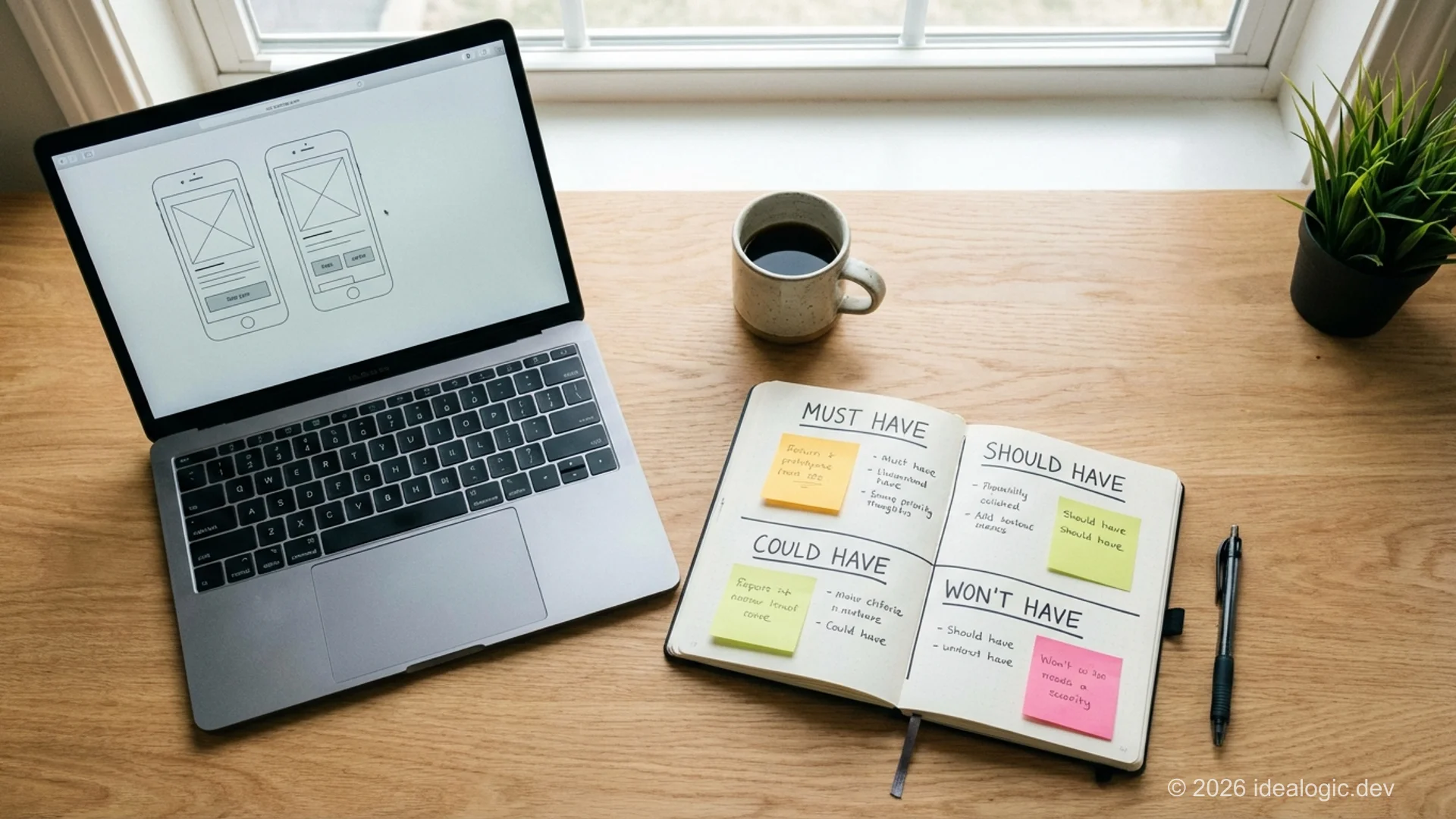
In practice, it works like this:
- Write down every feature you've ever imagined for your product. Get it all out of your head.
- For each feature, ask: "Can a user complete the core task without this?"
- If yes, it's not a Must Have. Move it to Should, Could, or Won't Have.
- If no, it stays.
- Most MVPs need 3-5 Must Have features. Not 15.
The MoSCoW exercise also forces you to define what the "core task" actually is. If you can't articulate it in one sentence, your product idea might need more thinking. Consider booking an IT strategy consulting session before you start building.
A good product roadmap starts here. The Must Haves become your MVP. The Should Haves become your version 2. The Could Haves go into your backlog. And the Won't Haves? They might become entire new products someday, or they might never get built. Either way, you've made a decision instead of drifting.
If your MVP has more than 5-7 features, it's not an MVP. It's a full product wearing a disguise.
5 Steps from Idea to MVP Launch
This is the practical roadmap for building an MVP from scratch, whether you're technical or not.
Step 1: Define the One Problem You Solve (Week 1)
Not "we help people eat healthier." That's a mission statement, not a product. You need something testable:
"Busy professionals can order a healthy lunch delivered to their office in 30 minutes."
Use this template: [Target user] can [specific action] in [timeframe or condition].
If you can't fill in that sentence, spend more time on product discovery. Talk to potential users and figure out where the friction is. This stage is about user validation, not designing screens.
Step 2: Identify Your Riskiest Assumption (Week 1)
Every business idea rests on assumptions. Your MVP should test the one that, if wrong, kills the whole thing.
For the lunch delivery example: "People will pay $15 for a healthy lunch delivered in 30 minutes." That's the riskiest assumption. Other assumptions ("we can find restaurant partners," "delivery drivers are available") matter, but they're secondary. If people won't pay, there's no business. Test the scariest thing first.
Step 3: Map Must-Have Features Only (Week 2)
Use the MoSCoW method from the previous section. Your output should be a one-page feature list. Not a 30-page specification document.
For a sprint planning session, this might look like:
- Restaurant listing with photos and prices
- Cart and checkout with payment
- Order confirmation with estimated delivery time
That's it. Three features. Three things to build. Everything else waits.
Step 4: Build It (Weeks 3-10)
You have three main options here:
No-code tools (Bubble, Bolt.new, Lovable, Replit Agent): Best for simple products where speed matters more than customization. Today's AI-augmented development tools let non-technical founders build functional prototypes themselves.
Freelancers: Good for specific, well-defined projects. Risky if your scope isn't crystal clear or if you need ongoing iteration cycles.
Development agency: Best for custom MVPs that need solid architecture and a team that sticks around for version 2. Look for agencies that specialize in MVP development services and understand the lean startup methodology. A good agency will push back on your feature list, not just build whatever you ask for.
If you don't have a technical co-founder, an agency is often the safest choice. You get a full team and a structured process. Someone translates your business requirements into a technical plan so you don't have to.
Step 5: Launch to 50 People, Not 50,000 (Weeks 10-12)
Don't go for a big public launch. Start with a small group of early adopters who feel the problem most intensely and will give you honest feedback, not polite encouragement.
Collect three metrics from day one:
- Signups: How many people try it?
- Activation: How many complete the core action?
- Retention: How many come back within a week?
These numbers tell you whether you have something real. High activation but low retention? The product works but doesn't stick. High signups but low activation? Your marketing promises something the product doesn't deliver.
Based on what you learn, you have three paths: iterate (improve what you have), pivot (change direction based on what users want), or scale (it's working, time to grow). When you're ready to scale, scale your development team to keep up with demand.
MVP Launch Checklist
- One-sentence problem definition tested with 10+ potential users
- Riskiest assumption identified
- Feature list: maximum 5-7 Must Haves
- Build method chosen (no-code, freelancer, or agency)
- Analytics set up before launch
- 50-100 early adopters identified
- Success metrics defined (signups, activation, retention)
How Much Does an MVP Cost? (Real Numbers)
The answer is always "it depends." But let's get specific with real cost ranges based on what we've seen across hundreds of projects.
| MVP Type | What you get | Cost Range | Timeline |
|---|---|---|---|
| No-code MVP | Built with tools like Bubble, Bolt.new, or Lovable. Single core feature, basic UI. | $2,000-$8,000 | 2-4 weeks |
| Simple custom MVP | One core feature, web or mobile, custom-built with proper architecture. | $8,000-$25,000 | 6-10 weeks |
| Complex custom MVP | Multiple integrations, backend logic, payment processing, possibly mobile + web. | $25,000-$60,000 | 10-16 weeks |
With AI-assisted development becoming standard in 2026, timelines are getting shorter. Tools like Cursor, v0, and Bolt help teams move faster without cutting corners on quality. But AI speeds up writing code, not deciding what to build. Feature prioritization and architecture planning still take the same amount of thought.
The biggest factors that drive cost up:
- Number of features. The number one cost driver, every time. Cut one feature and you save weeks of work.
- Platform choice. Web-only is cheaper than web plus mobile. If you need iOS and Android on top of a web app, expect to double the cost.
- Third-party integrations. Payment processing, maps, messaging APIs. Each integration adds complexity and testing time.
- Design complexity. Custom animations and brand-specific design systems add cost. For an MVP, a clean standard UI is perfectly fine.
The most expensive MVP is the one that tries to do everything. The cheapest MVP is the one that tests the right thing.
For custom builds that need to last beyond the testing phase, custom software development is worth doing right from the start. Rebuilding from scratch because the MVP was held together with shortcuts usually costs more than building it properly. A good professional MVP development partner will help you balance speed against cost without sacrificing code quality.
7 Common MVP Mistakes (and How to Avoid Them)
After working with dozens of startup founders, these are the mistakes that come up again and again. All of them are avoidable.
1. Building too many features. The number one killer. You said "MVP" but you built a full product. Go back to the MoSCoW section, be ruthless, and cut everything that isn't a Must Have.
2. Skipping user research. You built what you want, not what your users need. Spend a week talking to real potential customers before touching a wireframe. User validation is not optional.
3. Ignoring feedback after launch. Launching and then not listening defeats the entire purpose. Set up weekly check-ins with early users. That's where the real learning happens.
4. Waiting until it's "perfect." Perfectionism is the enemy of learning. If you're not a little embarrassed by your v1, you launched too late. Reid Hoffman said that, and he was right.
5. Launching without success metrics. If you don't define "success" before launch, you can't measure it after. Pick 3 metrics. Write them down.
6. Testing with the wrong audience. Showing your MVP to friends and family is comforting but useless. You need honest feedback from people who match your target user profile and feel the problem you're solving.
7. Giving up after version 1. An MVP is the start, not the finish. Most successful products went through 2-3 major iteration cycles before finding product-market fit. Airbnb pivoted multiple times. Slack started as a gaming company's internal tool. Building a startup product takes years. The MVP just gets you into the game.
The Iteration Mindset
The companies that win aren't the ones with the best first version. They're the ones that iterate fastest. Your MVP will have problems. That's the point. Bug reports and confused users aren't failures. They're data that makes version 2 better. Treat negative feedback as a gift.
MVP vs POC vs Prototype
These three terms get mixed up constantly. They're related but serve very different purposes.
| POC (Proof of Concept) | Prototype | MVP | |
|---|---|---|---|
| Purpose | "Can this even work?" | "What will it look and feel like?" | "Do real users want this?" |
| Audience | Internal team, sometimes investors | Designers, stakeholders | Real end users |
| Functional? | Partially. Tests one specific technical risk | Usually not. Clickable mockup or wireframe | Yes. Works end to end |
| Users interact with it? | No | Sometimes (usability testing) | Yes, with real usage |
| Cost | $1,000-$5,000 | $2,000-$10,000 | $5,000-$60,000 |
| Timeline | 1-2 weeks | 2-4 weeks | 6-16 weeks |
| What you learn | Technical feasibility | UX and UI viability | Product-market fit |
Think of it as three stages of confidence. A POC proves the idea is technically possible. A prototype shows what the product could look and feel like. And an MVP proves that people actually want it enough to use it and pay for it.
You don't always need all three. If your product uses standard technology (a marketplace, a booking system, a SaaS dashboard), skip the POC. The technology is proven. Go straight to an MVP or a quick prototype.
But if your product relies on something technically uncertain, like a novel hardware integration or an unusual AI application, start with a POC. Prove it works before spending money on design and user testing.
Ask yourself: what's my biggest risk right now? If it's technical ("can we even build this?"), do a POC. If it's design ("will users understand this?"), build a prototype. If it's market demand ("will anyone pay for this?"), go straight to an MVP.
In practice, many startups combine these stages. You might build a quick POC to prove your algorithm works, create a clickable prototype to test the user flow with 5-10 people, and then build your MVP with only the validated features. That sequence takes longer, but it reduces the chance of building something nobody wants or can use. What matters is knowing which stage you're in. Don't confuse a prototype for an MVP or an MVP for a finished product.
FAQ: MVP for Startup Founders
Below are the questions we hear most often from founders who are just getting started with the MVP process.
On This Page
- An MVP Is Not a "Cheap Product"
- What MVP Actually Means (and What It's NOT)
- Why You Need an MVP
- How to Decide What Goes In: MoSCoW for Non-Programmers
- 5 Steps from Idea to MVP Launch
- How Much Does an MVP Cost? (Real Numbers)
- 7 Common MVP Mistakes (and How to Avoid Them)
- MVP vs POC vs Prototype
- FAQ: MVP for Startup Founders