
Introduction
The 2026 UK IT job market may not see dramatic improvement overall. The opportunities of the IT job seekers, however, will increase in 2026 as long as they actively develop technical skills and enhance soft ones. As we move into the new year, the UK tech hiring landscape is expected to show strong demand for professionals with AI jobs UK, data jobs UK, and cyber security jobs UK skills—alongside specialists with deep industry experience and in-demand technical stacks. Despite a challenging permanent IT job market and limited economic growth expected in 2026, many organisations will continue investing in core technology priorities.
Successfully navigating the UK tech job market 2026 means understanding where demand is strongest, tracking hiring signals, and knowing how to pivot and upskill to improve employability in 2026 and beyond.
UK IT Job Market 2025: What happened to Permanent Hiring?
In 2025, there were both positive and negative developments in the UK IT job market. The growth had higher indications in the beginning of the year, but in the second half the activity declined. Nevertheless, in the most recent data of KPMG and REC 2025 was not a purely negative picture. Although permanent job vacancies decreased in October 2025, the decrease was not so rapid as it was in the beginning of the year. In the context of 2025 technological recruitment, a part of the story is the increasing use of AI in the industry. According to a survey conducted recently, 66% of enterprises are decreasing entry-level recruitment because of AI. This aligns to larger trends in IT employment 2025 with tech experts possessing niche and specialist knowledge obtaining additional opportunities, whereas non-specialist and junior workers obtained fewer.
IT Hiring Prognosis 2026: What the UK Tech Applicant must anticipate
Economic growth of 1.4% in 2026 as estimated by the Office of Budget Responsibility (OBR) is a reduction of a past figure of 1.5% and does not reflect high and sustained economic growth. Political and regulatory changes will also influence the UK IT job market 2026. The Employment Rights Bill is one of the largest, which was announced in 2024 and is likely to get Royal Assent in 2026. This has brought about more reservations on permanent workforce planning. Any possible amendments to consultation, such as extending unfair dismissal - right on Day 1 to right on 6-months-later may reassure some employers, but the bill can still influence recruitment in 2026 and later. The environment of 2026 hiring will also be impacted through automation. With the companies lowering their staffing needs and laying off junior employees such as 1st line support and junior developers and replacing some of this workload with AI tools, IT job applicants in the UK ought to evaluate which jobs can be most easily automatable and proceed to upskill into higher value jobs to continue competing.
Regardless of whether a part of employers resort to increasing permanent recruitment because of the clarity of the regulations, labour costs are increased, and productivity in entry-level positions due to AI is becoming more available.
Ready to Future-Proof Your IT Career?
Discover which skills will dominate 2026 and start building them today.
The 2026 List of the hottest IT skills: AI, Data, and Cyber Security
Some of these skills and roles are anticipated to be in continued demand in 2026. This is fuelled by the adoption of technologies at a rapid rate, constant innovation, as well as the shortage of digital skills that persists across the UK.
Cyber Security Jobs UK: Demand Stays High
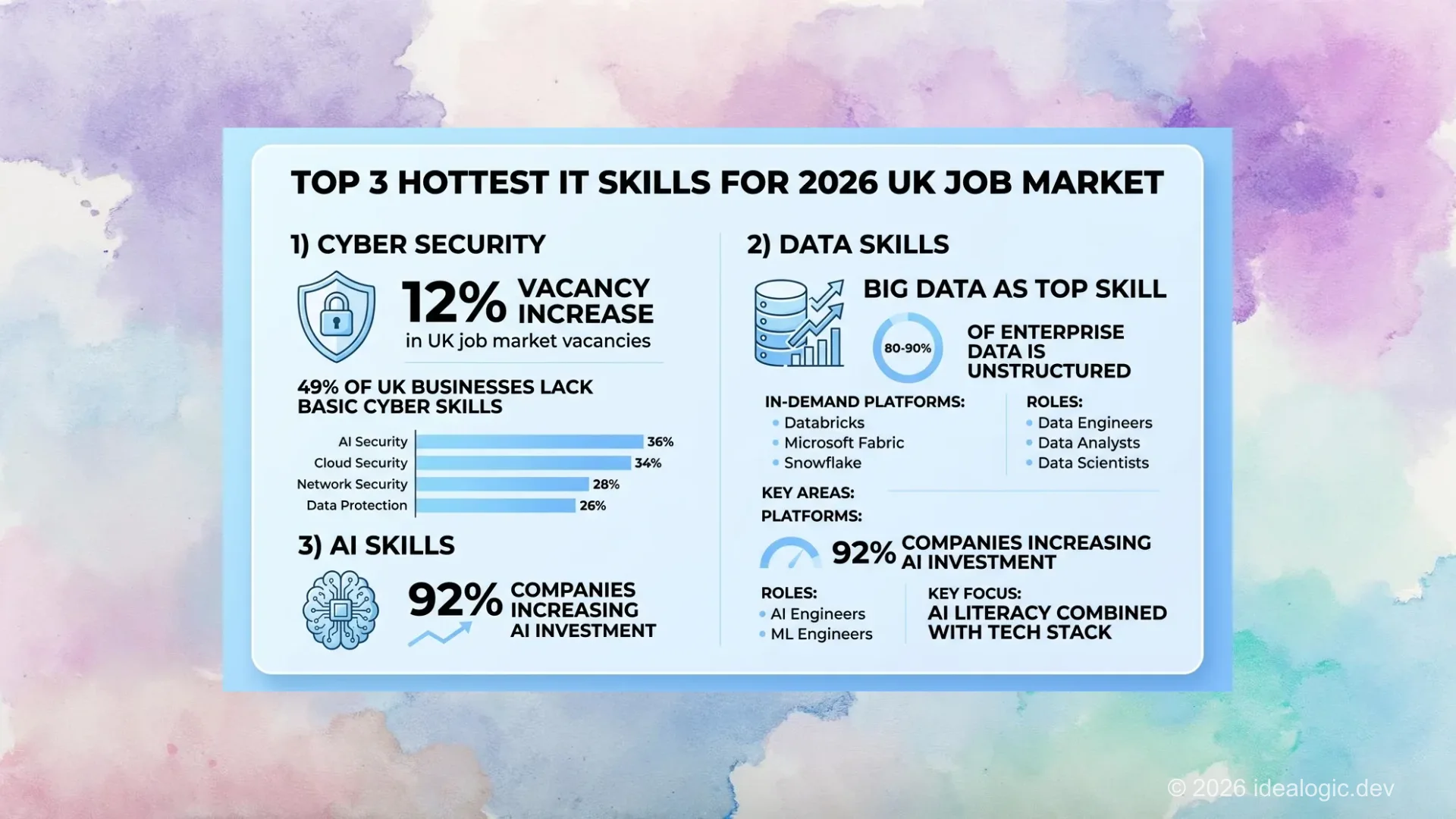
In 2025, cyber attacks took center stage, and M&S, Harrods, Adidas, and Jaguar Land Rover (JLR) were among the businesses that were besieged due to cyber attacks. The National Cyber Security Centre (NCSC) has reported that attacks had doubled in the last year and the centre is handling four nationally significant attacks each week in 2025. The experience of M&S and JLR indicates that ransomware attacks slowed down operations over months, and they led to the loss of multi-million pounds. Consequently, there was a 12 percent cyber security vacancy increment in 2025. The IT job market will not experience a downturn in the 2026 because organisations will focus on reducing risks and resilience to more advanced threats. As 49 percent of businesses in the UK say that they do not know the basic level of internal cyber security skill, the later of the investment in 2026, the more likely they become targets of the attacks, reputational harm, loss of revenue, and regulatory risk. As AI adoption and cloud migration continue, employers are increasingly hiring for cloud security jobs UK and security roles with AI awareness. PwC claims that cyber budgets will be guided by business priorities in 2025-2026 which will include:
- AI (36%)
- Cloud security (34%)
- Network security (28%)
- Data protection (26%)
This makes cyber security recruitment UK a major growth area in 2026.
Data Jobs UK: Big Data, Cloud, and Modern Platforms
The World Economic Forum included Big Data in the list of best tech skills in 2025. Data skills have been moved into the most desirable recruitment groups due to the emergence of data-driven decision-making and the use of AI. The future of data IT job seekers will not be phased out in 2026 because organisations will continue to require a substantial amount of assistance to process and operationalise data. One of them is unstructured data, which constitutes 80-90 percent of enterprise data. Businesses require professionals, such as data engineers, analysts, and data scientists, to clean, organize, and activate data to make decisions as well as to train AI models that lead to revenue and innovation. The demand at the top of the levels and specialization is general, yet platform experience (Databricks, Microsoft Fabric, Snowflake) will impose an additional burden on specialists. This strengthens demand for data engineer jobs UK and cloud data specialists.
AI Jobs UK: Strong Growth in 2026
The AI skills will not be availed of the least requested ones in 2026. With 92% of companies planning to increase AI investment over the next three years, roles such as AI engineer jobs UK and machine learning engineer jobs UK are expected to see sustained growth. AI engineers develop the smart systems and predicting models which are relevant to the business requirements: customer behaviour, industry requirements, operational workflows and so on. The need of AI engineering will grow as additional businesses adopt AI in 2026. Non-AI professionals can enhance their employability by acquiring AI tools applicable in its role. One of the most realistic methods of future-proofing a career in the UK tech job market is to combine AI literacy with an existing tech stack and understanding of an industry.
How IT Job Seekers Can Win in the UK IT Job Market 2026
Technology/ Industry Specialisation
It is possible that a transition into specialist positions can contribute to better employment opportunities. Specialist experience, regardless of training in a particular tech stack or creating dedicated knowledge in a single industry, can assist candidates to have a superior position and represent themselves among the broader applicant pool.
Upgrade Soft Skills in Enterprise Tech
In addition to technical knowledge, employers are also emphasizing on communication, stakeholder management, and teamwork. When AI replaces repetitive jobs, applicants with such human skills will be different—they will be more difficult to replace. The merging of AI-permitted efficiency and good soft skills can be a powerful benefit in the UK IT job market in 2026.
How to Optimise Your CV and LinkedIn to Recruiters and ATS
In order to gain opportunities, job seekers must maximize their CV and online profiles - particularly Linked In - to increase their visibility to recruiters and hiring managers. As Applicant Tracking Systems (ATS) become a trend, IT job seekers are advised to prepare the CV in the ATS format:
- Plain text format
- Brief points in bullets
- Quantifiable results
- Keywords in accordance with specialty skills
Another avenue to recruiter discovery on the CV is to ensure that the LinkedIn profile is updated with key role keywords, project, and achievements.