Introduction
The amount of IT spending is soaring. Sixty-one percent of the companies intended to spend more on technology in 2024. A different report released by Gartner revealed that 92 percent of firms thought of investing in AI tools. It is an increase that is international and it is not decelerating. According to Gartner, IT spending will go up to 5.6 trillion across the globe. The actual question therefore is: what is it that businesses should concentrate on to remain competitive? This paper will consider the new technologies that the software industry has to offer, which will transform the world as we know it. Let's dive in.
In a Nutshell
By 2026, the software industry is to experience a significant change, which will include AI, automation, and smarter cloud solutions. Key trends include AI-powered development tools, low-code platforms empowering non-technical users, automated cybersecurity, and scalable cloud-native systems for hybrid work. Technologies like IoT, quantum computing, and the Internet of Behavior are enabling real-time insights and hyper-personalization. DevOps, FinOps and GreenOps are, meanwhile, streamlining delivery and costs and sustainability. Emerging innovations such as 5G edge computing, NFTs, and immersive AR/VR experiences are redefining how businesses build, secure, and deploy software.
Top Software Development Trends in 2026
It is apparent that 2026 will be an enormous year in software development before delving into individual trends. The fast growth in AI, codeless solutions, and utilization of cloud applications is making business rethink the way they design, develop, run, and track applications. They are also changing our working and level of service consumption. You will find out in the next few paragraphs what technologies are transforming the way work is done, speeding up the delivery process, and preparing the next 10-year wave of digital transformation.
Stay Ahead of Development Trends
Transform your software development with cutting-edge AI tools and cloud solutions.
1. Artificial Intelligence Becoming Your Daily Helper
By 2026, AI will be the standard tool in the stock of all developers, and it will no longer be novel, but will have become an indispensable element. Actually, 84 percent of developers already are or intend to use AI tools in their workflow, an increase of seven percent since 2020, and more than half (51) of developers use it every day. The use of such tools as GitHub Copilot, Claude and Claude Code, Cursor, and Windsurf are now used as smart pair programmers, providing:
- Real-time context-sensitive suggestions
- Code refactoring
- Automated documentation
The creators of AI apply it not just to write and debug code, but also run whole workflows, including architecture design and test generation though to the deployment and monitoring of applications. This change has redefined productivity. The current AI applications are multimodal, comprehending both code and text, and even voice recognition, enabling the developer to converse with the assistant as any other person would do. It can now be done in weeks instead of months, which the startups and small teams are now equal. At the same time, autonomous AI agents have emerged as powerful co-workers across industries, handling customer support through AI voice agents, managing CI/CD pipelines, or coordinating backend processes without human intervention.
Did you know? With these systems becoming more and more competent, the boundary between support and self-sufficiency is increasingly thinning, signaling the beginning of the intelligent, self-directed revolution.
2. Low-Code/No-Code Platforms Empowering Citizen Developers
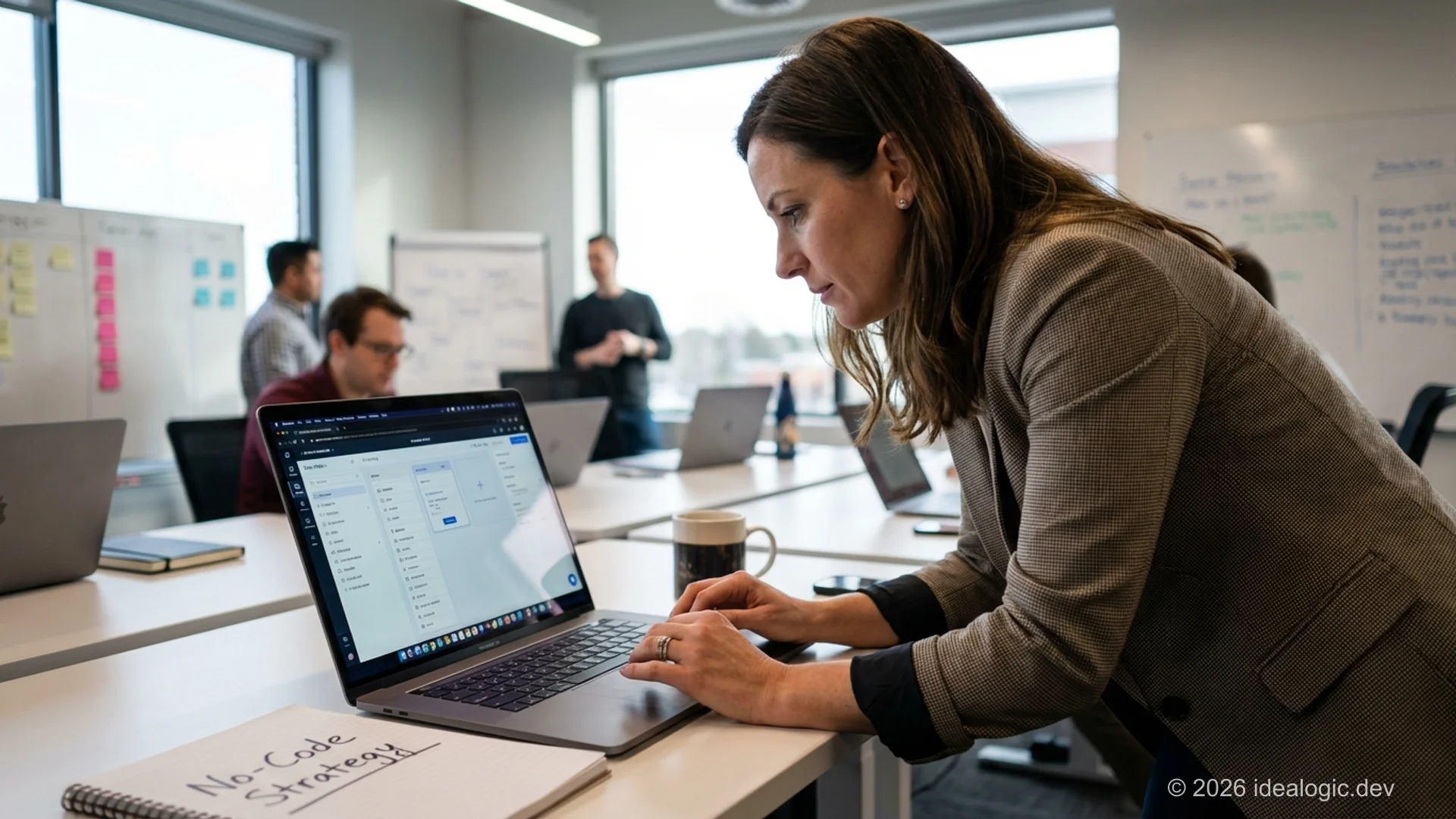
Not all the people that require an app are developers. One of the most recent trends in IT is low-code platforms and no-code platforms. All these allow individuals to create software by dragging and dropping blocks or writing very basic forms of code.
- Finance departments are able to spin up budgeting software
- HR is able to develop onboarding processes
- Marketing is able to roll out campaign microsites all within days
This trend is exploding. Gartner estimates that the market of low-code technologies will reach 44.5 billion by the year 2026. These mediums accelerate the pace of digital transformation and reduce the backlog. But there's a catch: without guardrails, "citizen developers" could create apps that lack security checks or version control. That's where platform engineering teams step in. They implement API regulations, automatic security tests, and connection to the git repositories that allow ensuring that each new form or report satisfies the company and compliance requirements. The result is a hybrid world. Simple applications can be constructed in a short time by non-technical teams, whereas software engineering teams are able to work on complicated projects and safety tests. It all runs on an integrated development platform which provides the agility to businesses to be able to experiment without mess.
3. Cybersecurity Automation for Proactive Threat Defense
The rate of cyber threats is increasing at a rapid pace and hence keeping software secure is all the rage in the year 2026. Ransomware is one of the major threats, in which attackers encrypt information and charge finances. As a matter of fact, in 2023, 59 percent of businesses became targets of ransomware. Meanwhile, rogue coders are employing malicious code writing to create crafty applications that bypass simple security measures. In retaliation, businesses are relying on AI-powered automation, which uses intelligent tools to identify and block threats on the fly, rather than allowing human operators to miss any warning. Another key part is platform engineering, where teams build shared systems that bake security into every step of making and delivering code. In this manner, safety checks are performed automatically prior to app release, reducing weak points. Adopting a zero trust architecture further strengthens defenses by requiring continuous verification of every user and device, regardless of network location. Together, these approaches shape sustainable software development by making products both reliable and secure.
Warning: The combination of AI, powerful platforms, and current cybersecurity protection in 2026 will assist companies in staying restricted to hackers and securing user data.
4. Cloud-Native Architectures Powering Hybrid Workforces
Remote and hybrid work models have accelerated the use of the cloud computing demand. Nearly one-third (33%) of organizations now spend more than $12 million annually on public cloud services, reflecting how critical cloud-native architectures have become for enabling distributed teams. The International Data Corporation (IDC) predicts that the percentage of cloud adoption will keep growing at a rate of two digits in 2025. Distributed teams have companies substituting the on-premise costly hardware with a microservices setup on AWS, Azure, or GCP. Cloud-hosted CI/CD pipelines, containerization, and serverless computing let developers release features around the clock and maintain uptime across time zones. It also results in more popularization of cloud-based remote work software, which is becoming more essential to distributed teams. This is more so in the case of businesses whose primary product is software as a service (SaaS) or platform as a service (PaaS). Expect a surge in platform engineering roles focused on building self-service portals that hide cloud complexity, letting engineers concentrate on writing reliable software.
5. The IoT Networks that are Powering Real-Time Optimization of Operations
IoT allows leaders to optimize the performance of assets, forecast maintenance requirements, and enable recurring income by aggregating and analyzing live data streams to support data-driven services. The adoption of IoT has been growing at an incredible pace among organizations that are looking to achieve efficiency, creating better customer experience and informing high-impact strategic decisions. In the world, the number of connected IoT devices had reached approximately 18.8 billion by the end of 2024. It is more than twice the number of people on the planet, and each of them hums and generates data to attract the attention of developers who transform it into useful apps and tools. IoT Analytics anticipates a market size of 21.5 billion in 2025 and 41 billion in 2030.
| Year | Market Size (Billions) | Growth Factor |
|---|---|---|
| 2024 | 18.8 | Current baseline |
| 2025 | 21.5 | 14% growth |
| 2030 | 41.0 | 91% projected growth |
Why is it a big deal to the software developers in 2026?
- To start with, the availability of additional devices presents additional opportunities to develop solutions that can be used to monitor health vital, water crops at the best moment, or even to reroute traffic in an occasion when the road gets congested
- Second, since these gadgets deliver continuous streams of data, these nuances require new platforms and code libraries to sort, secure, and analyze them in an expedient manner
- Finally, with businesses trying to automate all parts of their hospital rooms to city grids, the demand is high to hire experienced IoT developers who can help the business save time, reduce costs and provide more innovative services
6. Solving Enterprise Scale Problems with Quantum Computing
The quantum computing uses qubits. These build on exploiting superposition and entanglement to solve optimization, simulation and cryptographic problems much more challenging than with classical systems. In the next 15 years, the market size of quantum computing in the world will expand to $450-850 billion.
That is to say that large corporations are developing and testing quantum instruments alongside their customary applications. What is that like to software developers? They will combine some of the old-school code with some new quantum-related libraries, and they will run simple tasks of quantum computing on the cloud to solve the problems that are hard to solve by a classical computer. Such things as:
- Simulating molecules to discover drugs
- Discovering optimal paths in large delivery networks
Besides, teams can now test out cloud services without having to purchase expensive hardware.
7. Internet of Behavior: Insights-Driven Personalization
The Internet of Behavior (IoB) takes data from smart devices, like phones, watches, or in-store sensors, and learns what people do and like. Having learned about the browsing behavior, purchase history, and even to study the time that a person spends next to a product shelf, business can adjust the offers on the moment. It is one of the new software technologies, and therefore not very mainstream yet. The market size of the IoB stood at $432.2 billion in 2023 and will increase at a rate of over 23 percent/year up to 2032, as more AI tools, data analytics, and behavioral science will be available. The consumer IoB uses such applications as:
- Loyalty ones that propose offers according to the previous purchases
- Smart city systems that adjust the traffic lights to be safe and flow well
- B2B SaaS services can use the patterns of logins and support requests to compute scores of churn risk by learning which customers are likely to cancel their use shortly
But individualization should not violate privacy. The explicit consent is required by such laws as GDPR and CCPA, and new ethical considerations of the IoB are appearing. Secure data lakes, developed by developers, encrypt behavior data and federated analytics are used. It is at this stage that raw data remain on devices, and all the insights only travel to the cloud; a balance between customized experiences and user trust.
8. DevOps and CI/CD Pipelines for Continuous Innovation
DevOps unites developers and IT departments to create, test, and deploy software more quickly and with high reliability. In contemporary software development, we are talking of automated workflow. This is known as CI/CD pipelines that power continuous software delivery. In February 2024, an analysis of GitHub repositories revealed that 32.7% of the repositories already installed CI/CD technologies. The program now includes automated delivery as an essential element of the process of code getting out into the world. Such pipelines automatically perform:
- Tests
- Code generation
- App deployment
This ensures that new features and fixes are delivered to customers without human-to-human handoffs. This practice will reduce the amount of time taken to write code to live by 2026. What took weeks to occur is now taking hours. It also checks bugs sooner by running tests with each modification reducing the expensive rollbacks. DevOps and CI/CD are changing the way software is delivered in businesses and bringing consistency to the speed of update, reliability, and responsiveness of the business to client demands.
9. Fin Operations and Green Operations: Cost and Carbon footprint optimization
The teams increasingly are combining cost control and environmentally-friendly efforts. This has been known as financial operations (FinOps) and green operations (GreenOps). Combined, these two will help drive sustainable software development in 2026. FinOps assists companies to monitor and control their cloud bill in real-time. GreenOps introduces a green twist to this by quantifying and reducing the carbon footprint of the said cloud usage. Combine them and you have cost effective and planet friendly software delivery. Why is this important in 2026?
- To begin with, the cost of the clouds continues to increase, as does the energy bills. IDC predicts that by 2024 FinOps had been implemented in approximately 60% of organizations
- Simultaneously, the power consumption and carbon emission monitoring tools in data centers are becoming a typical component of DevOps toolchains
This explosive AI-first engineering, envisage Copilot-style pair-programming assistants and code-quality bots with large language models, has resulted in teams executing larger and larger training jobs and inference pipelines in the cloud. Such workloads are deployed on big data-centers, and their increased power consumption has become a hot-tempered sustainability topic. The progressive organizations are thus giving priority towards deployments within a sustainable data center. These include plants that have been designed to use renewable energy, heat-recycle loops, and state-of-the-art cooling. By moving AI model training and CI/CD automation to these more sustainable infrastructures dev teams are able to continue to push the ML envelope and achieve their 2026 ESG targets.
10. 5G-enabled Multidimensional Edge Architectures of Latency-Critical Applications
A 5G network will be supported by more than two billion devices all over the world by the year 2025 and more than five billion by the year 2030. As data is zipping back and forth almost immediately, developers are creating new applications such as robotic process automation that can reside on the edge of the network automating your tasks on your phone or in your car without delays. Ultra-low latency and network slicing offered by 5G are today facilitating private, mission-critical applications in the market, consider:
- Real-time AR/VR training in the factory
- Extremely precise robotics in healthcare
- Dependable connectivity in autonomous vehicle fleets
Although some of these functions are still in the initial stages of commercialization and are mainly only used by large businesses or pilot projects, they are indicative of how swiftly 5G and edge computing is advancing. Companies can now start using edge-computed 5G architectures to process data in locations, initiate actionable insights in real time, and ensure service level guarantees on the latency sensitive workloads, which offers transformative efficiency and competitive differentiation over and above faster mobile browsing.
11. NFT Enterprise Asset Provenance Tokenization
The NFTs provide blockchain-based certificates of ownership of a digital asset, which makes every asset proved to be unique, and impossible to alter. Companies are using this ability to tokenize software licenses and supply-chain credentials, as well as proprietary digital assets, open up new ways to monetize, improve provenance tracking, as well as solidify auditability in an ecosystem. The NFT market in the world will reach $48.74 billion in 2025, and it is expected to increase 34.53% every year. So what is the significance of this to software developers in 2026? NFTs are powered on smart contracts, small pieces of code programmed into the blockchain that determine each NFTs behavior. Every sale and trade is carried out by these smart contracts. They automatically execute themselves when some conditions are fulfilled without the involvement of a middleman. That makes the purchase and sale quick, open, and inexpensive. Second, a lot of NFT projects are built with open-source software, which should be interpreted as everyone has access to it, can add new functionalities, or work on bugs. It brings international cooperation and creativity. Developers are making additional tools to:
- Mint NFTs
- Display NFTs
- Trade NFTs
As more artists, gamers, and brands enter the market. You will have marketplaces that operate on your browser, mobile applications that allow you to display your collection.
Did you know? The teams can utilize smart contracts and open-source libraries to implement new ideas in days rather than months. In 2026, NFTs will be more than art. They represent a means of ensuring the safety of commissioning software development projects through outsourcing.
12. Enterprise AR/VR Platforms of Immersiveness
AR and VR are going way beyond the games. Statista project that the revenue earned globally will be $46.6 billion in 2025 with the biggest market being the AR software. In 2026, the progressive web apps will start to interact with AR/VR headsets and smart glasses. Although the technology of doing so already exists, very few websites are yet to embrace it. This integration will continue to evolve as edge computing matures to allow faster and more seamless experiences that are instant on your headset. AR will transform such industries as education and retail to the extent that users can see the product and to interact with it prior to purchase. Such devices will narrow the difference between natural and digital experience by placing digital information on the actual environment. In more serious business sectors such as the medical industry, AR and VR are used in allowing medical students to practice in virtual worlds without risk to the patient. AR may help doctors in surgery; it superimposes the 3D anatomy of the patient and targets specific areas. Headsets become cheaper and the heavy graphics work is provided in the cloud. It will continue to reduce in size, be it physical or virtual, physical barriers, such as hands-free training in a hospital or 3D dashboards in a boardroom.
Conclusion
These strategic software trends are not industry buzz, but the levers that businesses need to draw in 2026 to have a competitive edge, operational resilience and a sustainable growth. By integrating AI-powered automation, cloud-native architectures, and robust security frameworks, organizations can accelerate innovation lifecycles, optimize cost structures, and safeguard critical data. By adopting microservices and distributed computing, scalability and availability on a global scale is guaranteed, whereas blockchain, IoT, and edge-enabled 5G implementations allow new sources of revenue through trusted and real-time data transfers. When mapping your technology road, it is important to focus on investments where you can achieve a quantifiable ROI, enhance compliance and auditability, and enable teams to react quickly to changes in the market.